
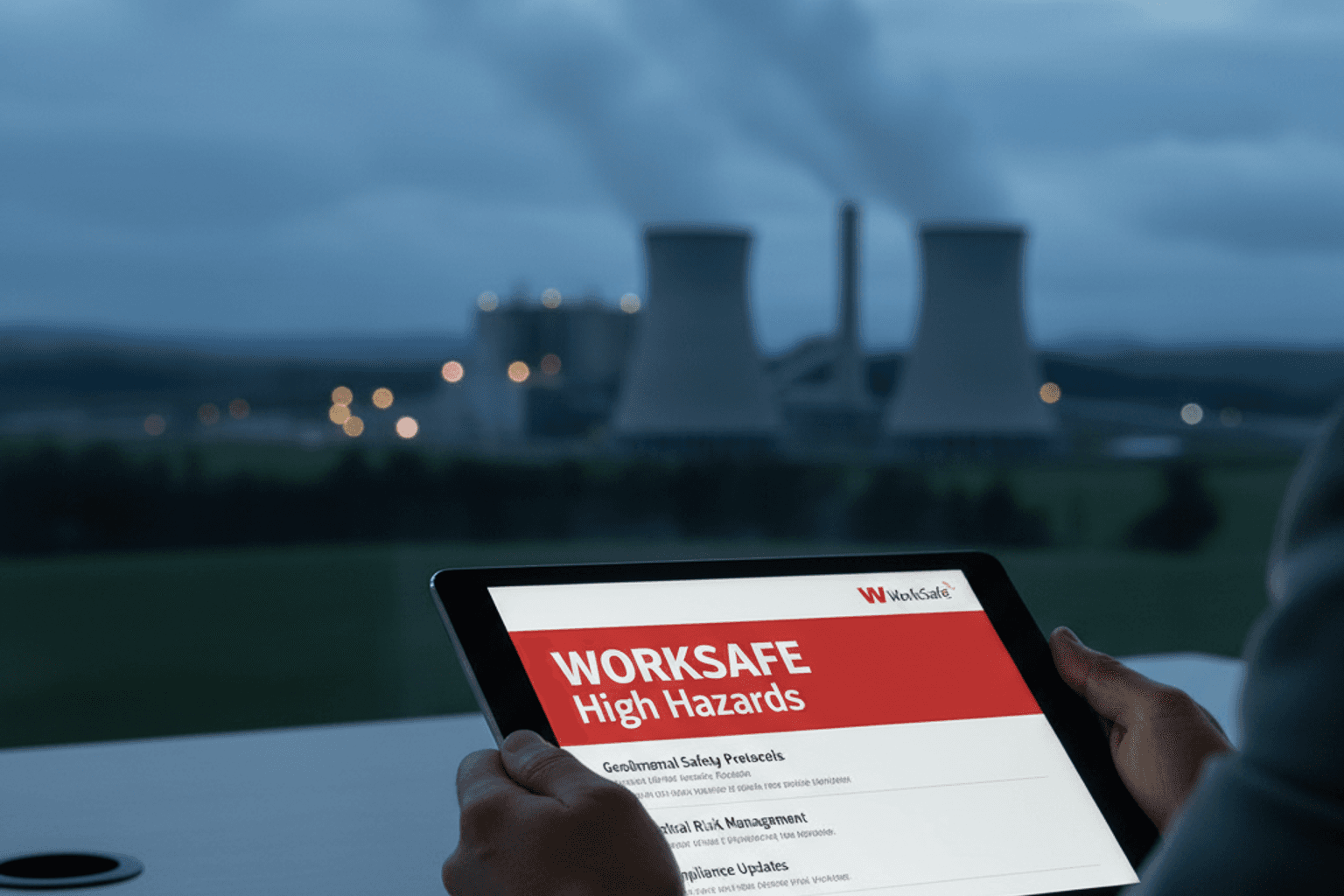



WorkSafe’s March 2026 Mandate: Why Your MHF Safety Case May No Longer Be Compliant
By the Engineering New Zealand Content Team
There is a dangerous comfort in a submitted Safety Case. Once accepted, it often sits on the server, a static monument to compliance. But WorkSafe’s latest communication suggests that for many Major Hazard Facilities (MHFs) in New Zealand, that comfort is about to end.
The March 2026 High Hazards newsletter, released on March 2, is not just a routine update. It represents a convergence of three critical timelines: the 15-year reflection on the Pike River Mine disaster, the 20-year legacy of the Buncefield fire, and—crucially for operators—the regulatory cycle for safety case revisions under the 2016 Regulations.
If you are a CPEng or Safety Manager in the geothermal or high-hazard sector, the regulator has just signaled where they will be looking next. The question is: will your documentation hold up to the scrutiny?
The News: A Signal, Not Just a Summary
On March 2, 2026, WorkSafe published its ninth High Hazards newsletter. While the document serves as a table of contents for the industry's current state, the specific line items reveal a targeted enforcement strategy.
According to the newsletter, WorkSafe is prioritizing:
- Natural Disaster Response Learnings: Integrating recent environmental data into safety cases.
- Geothermal Risk: Enforcing insights from the MHF forum and geothermal workshop held last year.
- Organisational Memory: A specific focus on "asset integrity learning" to combat the fading memory of past disasters.
- Safety Case Statistics: A new update on acceptance and rejection rates that implies a tightening of standards.
The Analysis: The "Silent Risk" of 2026
Why is this update significant now?
1. The 5-Year Regulatory Trap
The Health and Safety at Work (Major Hazard Facilities) Regulations came into force in 2016. Many facilities submitted their first robust safety cases in 2021. That puts us squarely in the 2026 revision cycle. WorkSafe’s mention of a "Safety case statistics update" likely foreshadows a wave of reviews where "copy-paste" revisions will be rejected.
2. The "Memory Gap"
The newsletter explicitly flags "Reflecting on 15 years since Pike River" and "20 years since Buncefield." This isn't sentimental; it's operational.
In engineering terms, 15–20 years is a generation. The senior engineers who designed your facility's safety critical elements (SCEs) are retiring. The new guard may know how to operate the plant, but do they know why a specific pressure relief valve was sized that way? WorkSafe is signaling that they will be auditing for organisational memory—checking if the "why" has survived the turnover.
3. The Geothermal Specifics
New Zealand’s geothermal sector is world-leading, but the "MHF forum and geothermal workshop" mentioned in the update implies that best practices have evolved. If your safety case relies on 2020 standards for H2S management or wellhead integrity, you may already be non-compliant with the "reasonably practicable" test.
The Action Plan: What Engineers Must Do
To stay ahead of potential enforcement action, engineering leads should take the following steps immediately:
- Audit Your "Natural Hazard" Assumptions:
- Does your safety case reflect the weather and seismic data from the last 3 years? If your flood risk modeling predates recent major cyclones, your safety case may no longer meet the "so far as is reasonably practicable" (SFAIRP) standard required by the Health and Safety at Work Act.
- Stress-Test Organisational Memory:
- Select three Safety Critical Elements (SCEs). Ask your junior engineers why they are there and what happens if they fail. If they can't answer, you have a competency gap that WorkSafe will find.
- Review the "Geothermal Workshop" Outcomes:
- Ensure the specific technical learnings from the 2025 forum are referenced in your hazard register. If you missed the forum, find the minutes or the summary document immediately.
- Check Your 5-Year Date:
- If your last safety case was accepted in early 2021, you are likely due for a mandatory revision. Do not wait for the letter from WorkSafe.
The Solution
Compliance in 2026 requires more than just technical knowledge; it requires a strategic approach to documentation and safety culture. To help you navigate these specific updates, we recommend engaging in specialised process safety training.
Providers such as IChemE (Institution of Chemical Engineers) offer courses like Fundamentals of Process Safety, and Engineering New Zealand frequently runs modules on the Health and Safety at Work Act. Ensuring your team is up to date with these foundational qualifications is the best defense against regulatory drift.
Disclaimer: This article provides professional commentary and does not constitute legal advice. Always refer to the official WorkSafe New Zealand publications for regulatory requirements.